Municipal & Industrial Wastewater

Water & Wastewater Treatment

Less Polymer, Less Struvite
Lower Running Costs

HydroFLOW® is a chemical-free physical water conditioner for wastewater treatment plants. It installs onto existing pipework — centrate lines, sludge lines, centrifuges, belt presses or DAF units — and transmits a 24/7 signal that reduces the polymer dose you need and treats struvite scale at the source. No pipe cutting, no shutdown, no chemicals added.

  • 200 l/hrPolymer saved on a belt press — Banbury WWTP, UK
  • 11%Less centrifuge polymer — Yorkshire WWTP, UK
  • 0 newStruvite scale in centrate lines — Luton WWTP, UK
  • $47.5kAnnual chemical saving — Maple Leaf, Canada

Results from named-site case studies; vary by site conditions and baseline operation. View all wastewater case studies →

Where Cost Hides in the Wastewater Treatment Process

From municipal wastewater treatment plants to food, dairy and paper effluent lines, four problems quietly push up chemical spend, sludge disposal costs and unplanned maintenance.

  • Struvite Scale on Dewatering Equipment

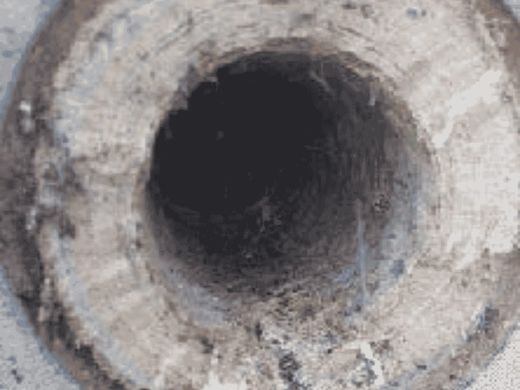
    Phosphorus, magnesium and ammonia in the sludge stream form hard struvite scale that blocks pumps, pipework, centrifuges and anaerobic digesters — especially where concentration rises during dewatering.

    ✓ With Hydropath The signal causes struvite minerals to crystallise in suspension instead of bonding to surfaces — reducing and treating existing deposits and easing new scale formation over time.
  • High Polymer Flocculant Use

    In order to ensure good separation of solids and liquids, and maintain acceptable parameters for the filtrate/ centrate and cake/ waste discharge, polymer flocculant needs to be added to the sludge/ waste stream, adding a high cost.

    ✓ With Hydropath The signal performs part of the flocculation electronically, so the dose can be turned down — a reduction of 10% or more, validated up to 20% in field trials — while keeping the same output parameters.

  • Wet, Costly Sludge Cake

    Weak flocculation means a wetter sludge cake at discharge — and the heavier and wetter the cake, the more it costs to press, transport and dispose of at a licensed site.

    ✓ With Hydropath More effective flocculation supports a drier, denser cake at the same dose, or equivalent cake solids at a lower dose — cutting the weight and volume hauled away.

  • Shutdowns & Manual Cleaning

    Struvite scale forces line shutdowns and acid or mechanical cleaning of pumps, pipework and centrifuge drums — and in a decanter centrifuge, even small deposits can unbalance a drum spinning at 1,000–4,000 rpm.

    ✓ With Hydropath With struvite adherence reduced, pumps and piping stay cleaner for longer — easing the frequency of manual or acid cleaning and the associated downtime.

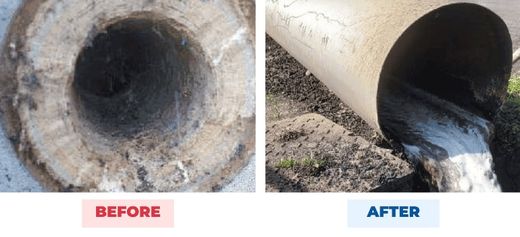
Luton WWTP centrate line before HydroFLOW, with hard struvite scale on the pipeworkBefore
Luton WWTP centrate line after HydroFLOW, with no new struvite scaleAfter

Luton WWTP (Thames Water East Hyde): no new struvite scale in the centrate lines over a 6-month trial, with reduced maintenance demand. Read the case study →

Lower Polymer Costs, Lower Sludge Disposal Costs

Struvite scale and polymer overdosing carry a continuous cost on every dewatering line. HydroFLOW® tackles both from a single fitting.

  • Drier Cake, Lower Disposal Cost

    More efficient dewatering raises cake solids content — directly reducing the weight and volume of sludge that has to be pressed, transported and landfilled.

  • Struvite Reduction & Treatment

    Ongoing 24/7 treatment reduces new struvite scale and gradually softens existing deposits in pipework, pumps and digesters — without acid descaling. Luton saw no new scale in 6 months.

  • No-Shutdown Fit, Fast Payback

    Fitted externally to existing pipework ahead of the dewatering equipment — no cutting, no downtime — so polymer and disposal savings start accruing immediately. Italy reported an 18-month ROI.

Don’t take our word for it — test it on your own line.

Every polymer-reduction claim on this page is designed to be independently verified using a documented, step-by-step testing protocol run on your own dewatering equipment.

The Technical Case

Two levers. Both measurable.

HydroFLOW® works on sludge dewatering in two specific ways — and both can be proven on your own line, with your own sludge, before you commit.

01 Polymer dosing

Turn down the polymer, not the performance.

HydroFLOW® works to flocculate the waste or sludge electronically, performing some of the work of the polymer flocculant. This means polymer dosing can be turned down — saving you money.

Sludge composition changes day to day, so polymer dosing is set high enough to survive the worst day. Our testing programme takes this into account, so you can be sure of the benefits.

  • What changes: with HydroFLOW running, part of the flocculation is done electronically — so the polymer set-point can come down.
  • What stays: the same buffer for feed-solids fluctuation. The saving comes out of the waste, not the safety margin.
  • 10%+
    typical polymer reduction
    up to 20%
    on trial centrifuges
    0
    change to your buffer
  • ✓ How we prove it on your line

    1. Baseline: unit off — record the minimum polymer dose that holds spec.
    2. Re-test: unit on — walk the dose down step by step.
    3. Compare: centrate TSS, cake solids and polymer dose at every step.
Electronic flocculationPolymer working doseFluctuation buffer
Standard dosing
100% polymer
Working doseBuffer
With HydroFLOW®
up to 20% less
SignalWorking doseBuffer
Where the saving comes fromSavedBuffer untouched — performance protected

The signal takes on part of the flocculation, so the working dose drops — while the buffer that protects performance stays exactly where it was.

02 Struvite

Keep minerals suspended, not scaled onto equipment.

Struvite (magnesium ammonium phosphate) forms where phosphorus, magnesium and ammonia concentrate — which is, awkwardly, exactly what your dewatering equipment does. So it scales from the inside out.

  • The mechanism: HydroFLOW's signal applies an oscillating field to the dissolved ions in the water.
  • The result: minerals crystallise as fine particles carried along in the flow — instead of bonding as hard deposit on pipes, pumps and centrifuges.
  • The difference: struvite is reduced and treated continuously, rather than chipped off by hand once it's already cost you a shutdown.
  • ✓ How we prove it on your line

    1. Scrape test: clean a marked area of pipe back to bare metal.
    2. Wait: run treated for a set period — typically three months.
    3. Check: has new scale returned? Have existing deposits softened?
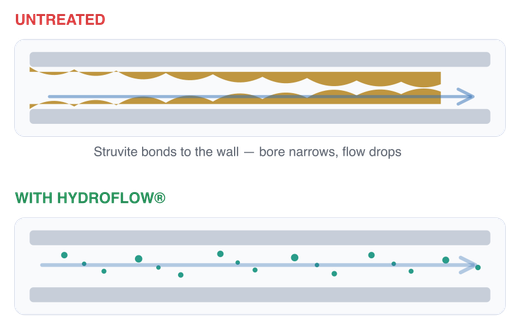
Diagram comparing untreated pipework with struvite scale bonded to the wall against treated pipework where minerals crystallise as fine suspended particles. Untreated: struvite bonds to the wall — bore narrows, flow drops. With HydroFLOW®: fine crystals carried in the flow.

Minerals still form — but as fine crystals carried away in the flow, not as a hard deposit growing on the pipe wall.

Process Overview

Simple Installation. Measurable Results.

Fitted upstream of the equipment or point of concern, with zero disruption to the line.

  • 1

    The Fit

    The HydroFLOW® unit installs around your existing pipework — ahead of the centrifuge, belt press, screw press or DAF separator. No cutting, no welding, no shutdown. Compatible with any pipe material.

  • 2

    The Signal

    A patented electronic signal propagates in both directions through the water, treating the whole line from a single point — working continuously, 24/7, on struvite and flocculation together.

  • 3

    The Results

    Flocculation improves within hours, supporting a documented polymer-dose reduction. Struvite adherence eases over the following months — verified by inspection or a simple scrape test.

Monitor Every Unit. From Anywhere.

Real-time remote monitoring and instant alerts for every HydroFLOW® installation, from anywhere in the world.

  • Hydropath Care

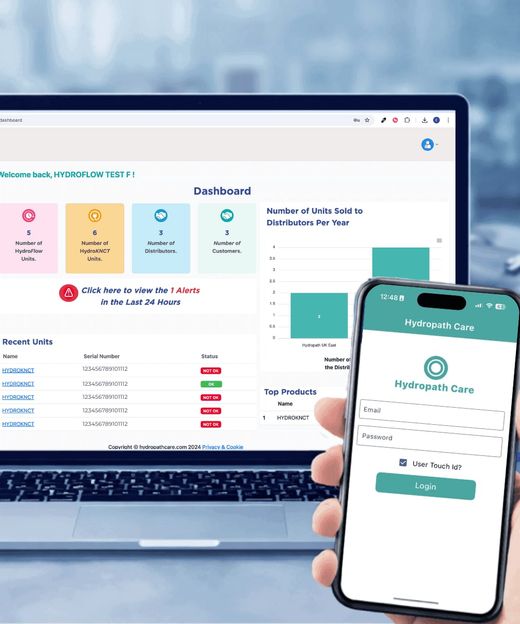
    Our remote monitoring platform gives you a complete overview of all your HydroFLOW® installations in one place. See which units are live, manage your projects, and stay in control — all from a single, easy-to-use dashboard.

  • HydroKNCT

    The IoT device that connects your HydroFLOW® unit to Hydropath Care via LAN. Simple to install and compatible worldwide — keeping you connected to your system 24/7. Add optional sensors to unlock real-time temperature and signal monitoring.

✓ Real-Time Alerts ✓ Cloud Analytics ✓ Zero Maintenance

HydropathCare remote monitoring dashboard and mobile app

Proven On Site

Real Sites. Real Results.

Verified wastewater installations across municipal dewatering, struvite control and industrial effluent.

  • Aerial view of the dewatering centrifuge site at Esholt WWTP, YorkshireWaste Water

    Yorkshire WWTP: 11% Less Polymer in Dewatering

    HydroFLOW i160 cut polymer demand 11% in sludge dewatering at Yorkshire Water's Esholt plant, output quality held.

    11%
    centrifuge polymer cut
    Lower centrifuge stress
    Output quality maintained
  • Aerial view of the Maple Leaf Foods plant, HamiltonWaste Water

    Maple Leaf Canada: 50% Ferric Cut, $47.5k Saved

    Two HydroFLOW Custom units cut ferric chloride dosing up to 50% while holding discharge compliance at a Hamilton food WWTP.

    50%
    ferric reduction
    91.8%
    cBOD reduction
    $47.5k
    annual chemical savings
  • Aerial view of the centrate line and centrifuge at East Hyde works, LutonWaste Water

    Luton WWTP: No New Struvite Scale in Centrate Lines

    A HydroFLOW unit prevented further struvite scaling in centrate lines at Thames Water's East Hyde works in Luton.

    0 new
    scale formation
    6 month
    trial duration
    Reduced maintenance demand

Applications

Key wastewater applications

One signal treats every part of the dewatering circuit — struvite and polymer dosing together.

Support & FAQ

Frequently Asked Questions

How much can polymer dosing actually be reduced?

Conservatively, 10% or more. In field trials, reductions have been validated higher — Yorkshire Water’s Esholt centrifuge cut polymer 11%, and a Banbury belt press saved around 200 l/hr — but treat it as a range that depends on your equipment, sludge chemistry and how tightly the current dose is already set. We’d rather quote a defendable minimum and let the testing protocol prove the ceiling on your own site.

Does HydroFLOW® remove struvite?

Over time, Hydroflow gradually softens existing scale and can aid in its removal over time.

At Denver’s Metro Wastewater Reclamation District, an independently verified trial recorded hard scale around 1/8 inch thick thinning until it was too thin to even sample — in 60 days. At Tulsa’s Southside plant, encrusted pipe could be scraped back to bare metal after treatment when that was impossible before.

The rate of removal varies with sludge chemistry, flow and the severity of existing scale; the effect is therefore verified directly on your line through a documented scrape test.

How is it installed on a dewatering line?

The unit installs externally around existing pipework, typically upstream of the centrifuge, belt press, screw press or DAF unit. There’s no pipe cutting, no welding and no need to take the line offline — installation is designed around zero disruption to ongoing operations.

Does it work on both aerobic and anaerobic treatment plants?

Yes, though struvite is considerably more common in anaerobic plants, where the chemistry favours crystal formation. On aerobic sites the polymer-reduction case is usually the primary driver; on anaerobic sites, both struvite reduction and polymer savings typically apply.

How do you prove the polymer savings on our site?

Using a documented testing protocol: polymer dose is stepped down with the unit off to establish a baseline minimum, then the process is repeated with the unit on, comparing centrate TSS, cake solids and polymer dose at each step. The difference between the two minimums is your verified saving.

Will it help reduce sludge disposal costs?

Indirectly, yes. More effective flocculation typically supports a drier sludge cake at discharge, which reduces the weight and volume that needs pressing, transporting and landfilling — on top of the direct polymer saving.

Ready When You Are

Ready to Cut Polymer and Struvite Costs?

Tell us about your dewatering equipment and current polymer use, and our team will scope a testing protocol to verify your savings on-site.