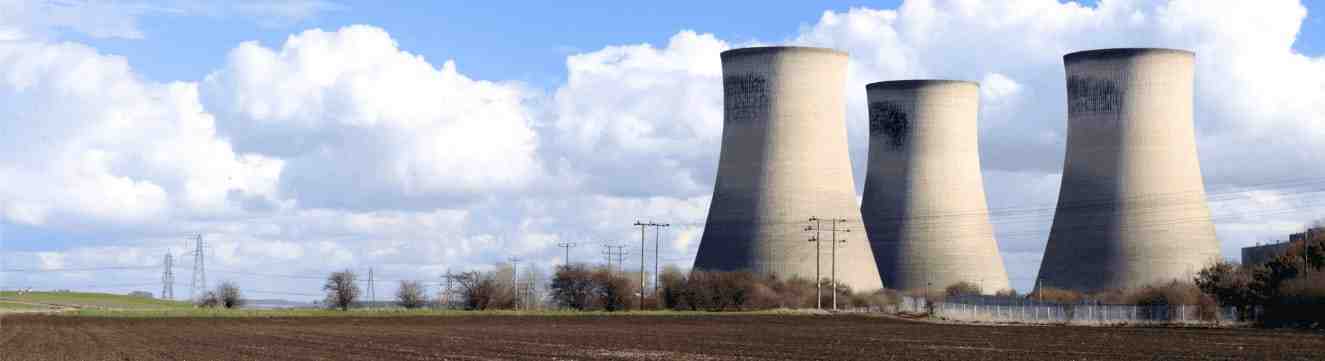
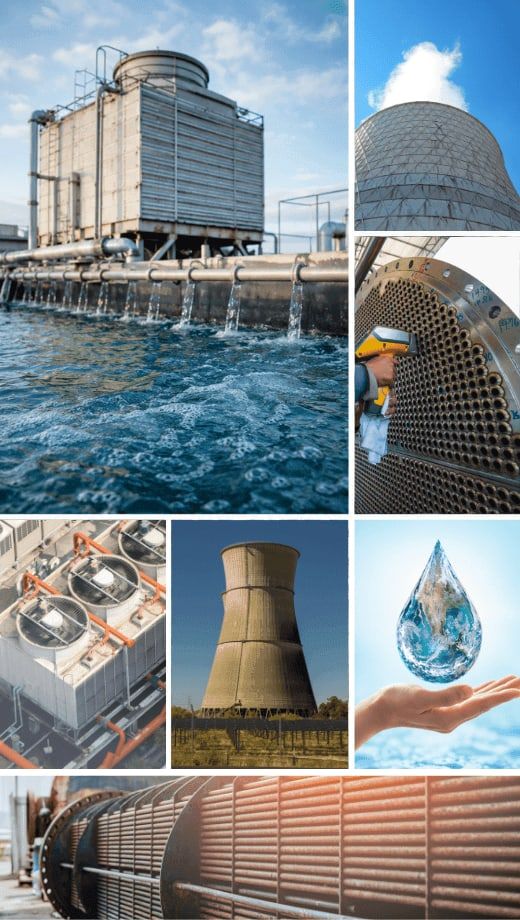
A cooling tower works by evaporation. Water leaves as vapour. The dissolved minerals stay behind.
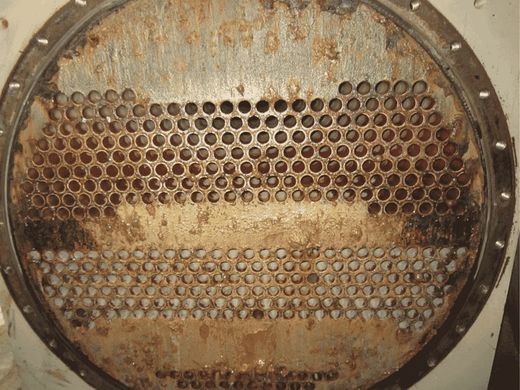
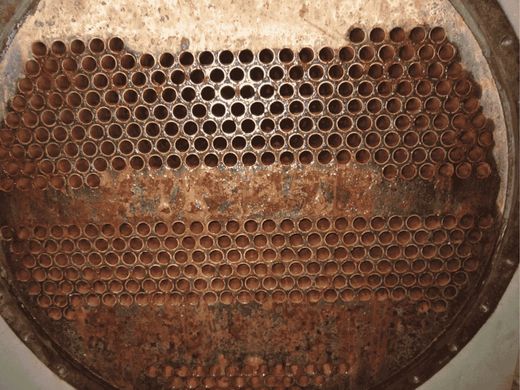
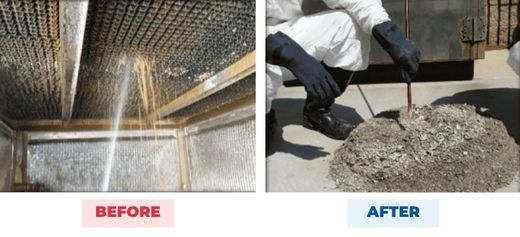
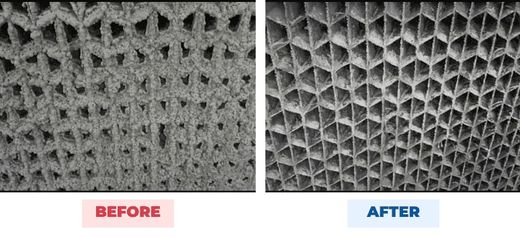
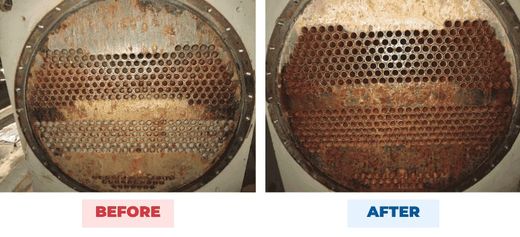
So the longer the water circulates, the more concentrated it gets. Eventually, those minerals hit their saturation limit and precipitate as scale. Scale forms on the warmest surfaces first: your heat exchanger or condenser tubes, and your fill.
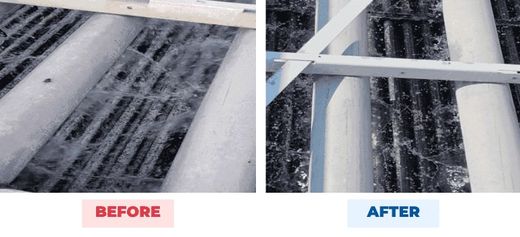
Scale isn't the only problem. In many towers, it isn't the main one. A cooling tower is close to an ideal environment for biological growth. Bacteria don't stay floating for long. They attach to surfaces, and they produce a protective gel. That gel shields them from the flow, and from chemical treatment. That layer is biofilm.
And biofilm insulates far better than scale. A millimetre of calcium carbonate costs you 7 to 9% of your heat transfer. A millimetre of biofilm can cost you up to 50%.
Both problems push you the same way: towards dumping water. Water evaporates. You bleed some to drain. Top up with fresh, and the concentration comes back down. That's blowdown. The total water discarded depends on how concentrated you let the water get first. And that is cycles of concentration. Three cycles means three times the dissolved load of the water you feed in.
The relation between cycles of concentration and blowdown is not linear. At two cycles, you bleed away as much as you evaporate. At three, half. At six, a fifth. The curve is steepest right at the start. And that's exactly where water chemistry tends to pin most towers.
So why not raise the set point? Because scale is a saturation problem. And the conventional answers work against the water, rather than with it. Strip the hardness out with a softener. Dose an inhibitor. Adjust pH. They all work, but only up to a point. Push far enough, and calcium carbonate still comes out.
The biology has its own version of the same trap. Biocide targets what's floating, and the exposed surface of the biofilm. The layers underneath can survive. They're sheltered by the gel, and by the dead cells above them. The system may appear clean according to free-floating bacteria levels. But within weeks, elevated counts can be back.
HydroFLOW takes a different route. It works like a transformer. The unit contains the primary winding. The secondary is both the water itself, and the pipe containing it. That's why the pipe material doesn't matter. Unlike a magnet, which treats only at one point, the signal travels. It runs both ways along the whole conductive path, at around 150 kHz, independent of flow rate. That means it reaches dead legs, and other places chemical cleaning and thermal treatment struggle with.
For scale, it encourages dissolved minerals to gather into suspended clusters. So when the water heats and becomes supersaturated, fine crystals grow on those clusters. They stay suspended, rather than sticking to your equipment or pipes.
For biofilm, the same signal destabilises the layer. Fragments detach and wash away. That removes the shelter the bacteria rely on.
At a Fortune 100 headquarters in Houston, HydroFLOW allowed the site to double its cycles of concentration, from 3 to 6, without scale accumulation. Blowdown fell by 85%. That helped save around $73,000 a year in water and energy.
A Texas factory was able to operate at 4,500 microsiemens, instead of 1,300. That's around three and a half times the previous level. Chemical use came down by 75%, and scale control held.
At a power station using seawater cooling, chemical dosing fell by 20%. And bacterial counts fell by 97%. Results vary according to site conditions and baseline operation.
And since nothing is added to the water, testing the water tells you only part of the story. The equipment is where you see the rest. The conductivity you can hold. Your approach temperature. Days between condenser cleans. Chemical consumption.
We'll go through those with you before anything goes on the pipe, so you know where you're starting from.
So if you're stuck at three cycles, or dosing more than you'd like, let's find out what your tower could actually do. Get in touch. Whatever the numbers say today, we'll watch them move with you.